Grouphorse in the News
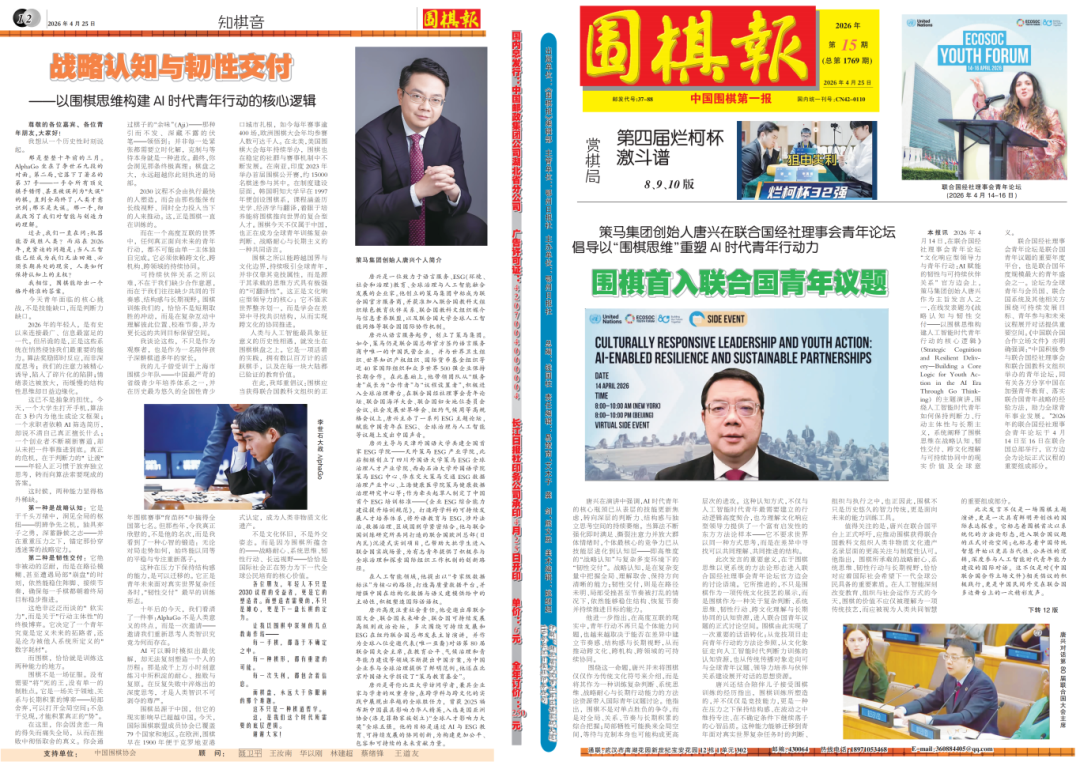
The full front page of Go Weekly features coverage of Grouphorse Group founder Tang Xing's speech at the United Nations: "Strategic Cognition and Resilient Delivery — Building the Core Logic of Youth Action in the AI Era with Go Thinking."
Updated:July 02, 2026On April 25, 2026, Go Weekly, widely recognized as "the premier Go newspaper in China," devoted its entire front page to an in-depth feature on the keynote speech delivered by Tang Xing, founder of Grouphorse Group, at the official side event of the United Nations Economic and Social Council (ECOSOC) Youth Forum on April 14. The side event was titled "Culturally Responsive Leadership and Youth Action: AI-Enabling ESG Resilience and Sustainable Partnerships." Tang's speech was entitled *"Strategic Cognition and Resilient Delivery — Building the Core Logic of Youth Action in the AI Era with Go Thinking."
The full text of the report is as follows:
Go Makes Its Debut in UN Youth Agenda | Grouphorse Group Founder Tang Xing Advocates Reshaping Youth Agency in the AI Era with 'Go Thinking' at UN ECOSOC Youth Forum
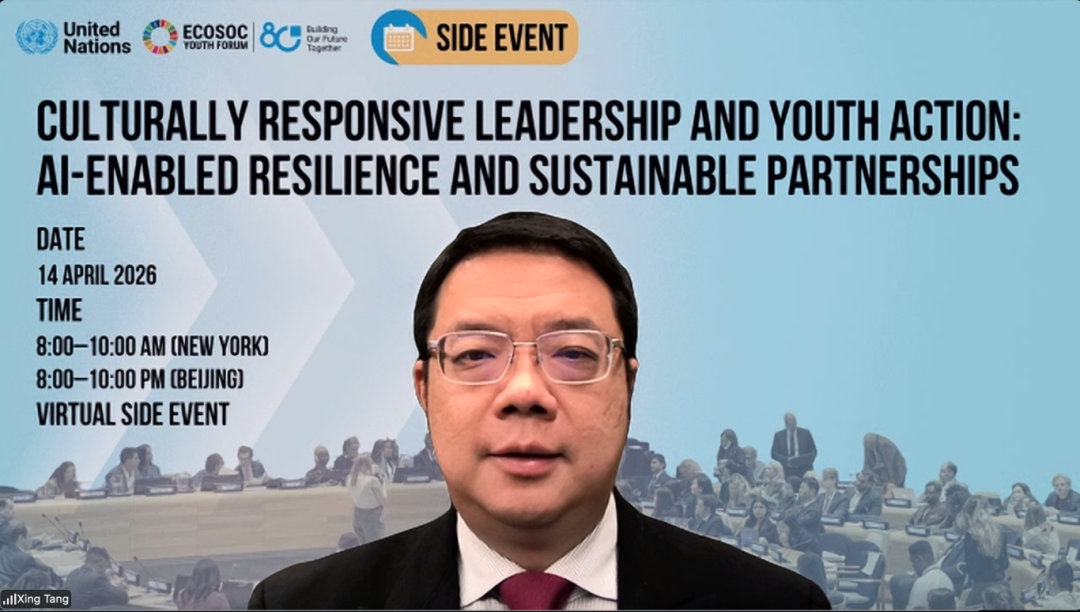
On April 14, 2026, at the official side event of the United Nations Economic and Social Council (ECOSOC) Youth Forum, titled "Culturally Responsive Leadership and Youth Action: AI-Enabling Resilience and Sustainable Partnerships," Tang Xing, founder of Grouphorse Group, delivered a keynote speech online entitled "Strategic Cognition and Resilient Delivery—Building a Core Logic for Youth Action in the AI Era Through Go Thinking." In his address, he systematically elaborated on the practical value and global significance of Go thinking in strategic cognition, resilient delivery, cross-cultural understanding, and sustainable collaboration, focusing on how young people can maintain judgment, agency, and long-termism in the age of artificial intelligence.
The UN ECOSOC Youth Forum is a major annual platform for youth issues at the United Nations and one of the largest annual youth gatherings within the UN system. It provides a vital space for dialogue among global youth, member states, the UN system, and other relevant stakeholders on the Sustainable Development Goals, youth participation, and future agendas. The *China-UN Cooperation Position Paper* also explicitly states: "China actively participates in the youth forums organized by the UN Economic and Social Council and UNESCO, sharing with all relevant parties China's experiences and methods in strengthening youth education and implementing the UN youth strategy, thereby contributing to the development of the global youth cause." The 2026 UN ECOSOC Youth Forum was held at UN Headquarters from April 14 to 16, with official side events constituting an integral part of the formal agenda.
In his speech, Tang Xing emphasized that the core bottleneck facing youth in the AI era has shifted from surface-level anxiety over skill upgrades to a deeper and ongoing erosion of judgment, structural sensibilities, and independent thinking. As algorithms increasingly reinforce instant gratification, fragment attention, and amplify group emotions, the most essential competitive edge for individuals has evolved from the skill layer to the cognitive layer—namely, high-dimensional "strategic cognition" and "resilient delivery" in complex and volatile environments. Strategic cognition is the ability to grasp the overall picture amid complex variables, understand trade-offs, and maintain clarity of direction; resilient delivery is the capacity to maintain structural stability, restore momentum, and persistently advance toward goals even when paths are unclear, setbacks occur locally, or rhythms are disrupted. He further noted that in a highly interconnected reality, youth action is no longer merely a matter of individual capability, but increasingly depends on the ability to establish a sense of rhythm, structure, and long-term perspective amid differences, thereby fostering sustainable collaboration across cultures, institutions, and sectors.
Addressing this proposition, Tang Xing did not present Go merely as a traditional cultural symbol, but rather introduced it into international youth discourse as a methodological resource for cultivating complex judgment, systems thinking, strategic patience, and long-term action capabilities. He pointed out that Go is not a contest over isolated wins and losses, but a comprehensive grasp of the whole board, relationships, rhythm, and long-term accumulation; local sacrifices may yield greater spatial advantages, and waiting and restraint can themselves constitute a higher form of offense. This mode of thinking not only aligns closely with the core logic of action that young people in the AI era most need to establish, but also offers an illuminating Eastern methodological model for understanding culturally responsive leadership—one that does not demand that the world think in a single way, but rather seeks structures that can be commonly understood and jointly advanced amid differences.
The significance of this address lies in the fact that Go thinking, in a more systematic methodological form, entered the discourse context of an official side event of the UN ECOSOC Youth Forum. What it advanced was not merely a display of Go as a traditional cultural art, but the introduction of Go as a cognitive resource for complex judgment, systems thinking, resilient action, cross-cultural understanding, and long-term collaboration into the formal deliberative space of UN youth agenda. In doing so, Go achieved an important discursive transformation: from a competitive pursuit to a methodological reference for youth action, from a cultural symbol to a cognitive resource for judgment training in the AI era, and from a traditional object of cultural dissemination to an intellectual resource capable of engaging in dialogue with global youth issues, leadership development, and partnership building.
Tang Xing also drew on his experience accompanying his son through Go training, noting that Go cultivates not only competitive ability but also a mental quality of maintaining structural sensibilities under pressure, sustaining focus amid volatility, and continuing to make moves under uncertain conditions. This capability can be transferred to young people's judgment, organization, and execution when confronting complex real-world tasks. For this reason, Go is not merely a time-honored intellectual tradition but also a future-oriented capacity-building tool.
Notably, Tang Xing formally called on the UN platform for Go to receive greater attention and institutional recognition at the level of UNESCO Intangible Cultural Heritage. He pointed out that the strategic patience, systems thinking, resilient action, and long-term vision embodied in Go correspond precisely to the essential qualities that the international community hopes the next generation of global citizens will possess. At a time when artificial intelligence is profoundly reshaping education, organizations, and societal operations, the value of Go should not be understood merely as a traditional skill, but as an important component of humanity's shared wisdom.
This address was not only a speech on the theme of Go, but also a distinctly pioneering exploration of international expression. It marked the first time that Go, in a systematic methodological form, has entered the formal deliberative space of UN agenda items. It also signified that traditional Chinese wisdom has begun to engage deeply, through a more contemporary and public-spirited logic, in international dialogue on youth capacity-building in the AI era. This represents not only an active implementation of the relevant initiatives in the *China-UN Cooperation Position Paper*, but also a compelling articulation of Chinese civil diplomacy on the multilateral stage of the United Nations.
Here is the full(translated)speech text:
Strategic Cognition and Resilient Delivery — Building the Core Logic for Youth Action in the AI Era Through Go Thinking
Distinguished guests, dear young friends, good day to you all.
I would like to begin with a historic moment. It was exactly ten years ago, in March. AlphaGo sat across from Lee Sedol 9-dan. In the second game, it played the famous move 37—a move that left all top Go professionals bewildered, and was even misjudged as a "mistake." It was only at the end of the game that humanity realized: that was no mistake. That single move completely rewrote our understanding of intelligence and creativity.
In the past, we kept asking: Can machines defeat humans? But standing here in 2026, the more urgent question is: When artificial intelligence has become an inescapable reality that we must coexist with for the long term, how can humanity maintain cognitive sovereignty? I believe Go can offer a remarkably precise answer.
The core challenge facing young people today is not a skills gap, but a judgment gap. The youth of 2026 are the most connected and information-rich generation in history. Yet paradoxically, it is precisely these very systems that are quietly eroding our most important capabilities. Algorithms reward instant reaction over deep thinking; our attention is subtly engineered into fragmentation; emotional expression is amplified, while slow structural thinking is increasingly marginalized. This is no abstract concern. Today, a college student opens their phone and an algorithm generates a thesis framework in three seconds; a job seeker relies on AI to filter their resume, yet cannot articulate what they are truly good at; an entrepreneur constantly chases new trends, yet never sees a single endeavor through to completion. The real crisis lies in the "delegation" of judgment—young people are becoming accustomed to abandoning independent thought and instead turning to algorithms for ready-made answers.
At such a time, two capabilities stand out as particularly rare. The first is strategic cognition: the ability to discern the pivotal nodes within a complex web—to recognize the opportune moment to advance, to possess the courage to sacrifice, to harbor the resolve to wait with composure—and, under immense pressure, to anchor that strategic certainty that cuts through the fog. The second is resilient delivery: this is by no means passive endurance, but rather the capacity, even when the path is unclear or a local "collapse" occurs, to steady oneself, regain rhythm, and ensure that every move steadily advances toward the ultimate objective. This is not some vague notion of "soft skills," but the ultimate contest of "agency." It determines whether a young person becomes a pioneer who shapes the future, or is reduced to "digital fodder" defined by systems designed by others.
And Go is precisely the arena where these two capabilities are cultivated. Go is not about conquest. There is no king to "checkmate," no single point of victory. It is a game of territory, relationships, and long-term accumulation—local sacrifices may open up greater spatial possibilities; by refraining from cashing in too soon, one accumulates true "potential" (influence). In Go, you lose the entire game because of greed over a corner, and in that defeat, you come to grasp the true meaning of trade-offs. Through the "aji" (lingering potential) of stones—those latent possibilities that lie dormant, unrevealed—you learn that not every tension needs immediate resolution; restraint and waiting are themselves a form of offense. Ultimately, you come to see the ultimate truth: the board is always larger than the local point you are fixated on at any given moment.
The 2030 Agenda will not be shaped by those who execute the fastest, but by those who can maintain a long-term perspective while simultaneously committing themselves fully to the present. This is precisely what Go has always been training. And in a highly interconnected world, no truly future-oriented youth action can be accomplished by a single actor alone. It must rely on sustained collaboration across cultures, institutions, and sectors. Sustainable partnerships are difficult not because we lack the will to cooperate, but because we often lack a shared sense of rhythm, structure, and long-term vision. What Go trains in us is not the impulse for short-term victory, but the ability to understand each other's positions within complex interactions, calibrate rhythms, and preserve space for longer-term shared objectives.
I speak of these things not merely as an observer, but also as a parent who has accompanied a child through years of deep immersion in the Way of Go. My son once trained with the Shanghai Junior Go Team—one of China's most rigorous provincial-level youth development systems—and placed seventh nationally in the "Seedling Cup," the oldest national youth Go tournament in China. But over those years, what truly gratified me was not his ranking, but the mental forging I witnessed: regardless of how the game unfolded, he was able to reset and place his next stone with the same composure and focus. This ability to maintain structural sensibilities under pressure is transferable. It is the earliest training ground for "resilient delivery" when young people later confront complex real-world challenges.
Ten years on, we have come to see one thing clearly: AlphaGo was not the end point of human meaning, but an invitation—an invitation to rethink what human intellect truly exists for. AI can instantly simulate optimal solutions, but it cannot replicate the process that shapes a human being: the patience, setbacks, and recovery accumulated over thousands of hours of deliberate practice. Deep thinking honed through repeated failure is the inalienable dignity of human intellect.
Although Go originated in China, its real-world influence has long transcended China. Today, the International Go Federation has member associations spanning 79 countries and regions. In Europe, Go took root as early as 1900 in the Croatian port city of Rijeka; today, over 400 tournaments are held annually, and the European Go Congress draws around a thousand participants each year. In North America, the U.S. Go Congress is held annually, and Go continues to develop through stable community and tournament structures. In South Asia, India held its first Go Open Tournament in 2023, drawing approximately 15,000 enthusiasts. On the institutional front, South Korea's Myongji University established a Department of Baduk as early as 1997, with a curriculum covering history, economics, and translation, aimed at cultivating interdisciplinary talent capable of introducing Go to the world. Today, Go belongs not only to China, but is also becoming a common language for young people worldwide to train complex judgment, strategic patience, and long-termism.
The reason Go can transcend national and cultural boundaries and continue to attract global youth lies not merely in its competitive nature, but in the high degree of "translatability" of the thinking it embodies. This is the essence of culturally responsive leadership: it does not demand uniformity, but rather teaches us to find consensual structures amid differences, thereby enabling cross-cultural collaborative progress.
The most symbolic historic encounter between humanity and artificial intelligence took place on the Go board. It is a living practice, with millions of active players and educational value that has been proven on every continent. Here, I solemnly propose: Go should receive formal recognition from UNESCO as an Intangible Cultural Heritage of Humanity. Not out of cultural nostalgia. Not as a diplomatic gesture. But because what Go embodies—strategic patience, systems thinking, resilient action, and long-term vision—is precisely the core value that the international community is striving to cultivate for the next generation of global citizens.
Dear friends, young people are not merely beneficiaries of the 2030 Agenda; they are its shapers. And shapers need not only ambition, but also the composure to play a long game. Let me conclude with a few profound lessons from Go—Every move is made in uncertainty. Every shape can be rebuilt. Every loss contains information. And the board is always larger than the problem immediately before you.
This is not merely a philosophy of the game. This is the foundational logic our era demands.
Thank you all!