Grouphorse in the News
Grouphorse representatives attended the UN High-Level Meeting (AI and Emerging Technologies Special Session) at the UN Headquarters.
Updated:July 06, 2026On June 30, 2026 (Eastern Time), the UN High-Level Meeting on "Strategic Capacity-Building: Addressing the Misuse of Artificial Intelligence and Emerging Technologies" was held at the United Nations Headquarters in New York. Tang Xing, Chairman of Grouphorse Group, and Guo Lingxin, Director of AI Data and Strategic Cooperation at Grouphorse Group, jointly attended the meeting. During the session, UN officials, national delegates, and heads of international organizations engaged in in-depth presentations and multilateral dialogues on the development trends of artificial intelligence, potential risks of misuse, and pathways for systematic governance.

▲High-Level Meeting on AI and Emerging Technologies Convened at UN Headquarters.
This thematic session was one of the core agenda items of the 4th High-Level Meeting of the Heads of UN Counter-Terrorism Agencies, co-chaired by His Excellency Abdulaziz Al-Wasil, Permanent Representative of the Kingdom of Saudi Arabia to the United Nations, and Ms. Noda Akiko, UN Assistant Secretary-General and Director of the Crisis Bureau at the United Nations Development Programme (UNDP).
The session was also attended by Mr. Amandeep Singh Gill, UN Under-Secretary-General and Special Envoy on Digital and Emerging Technologies, Mr. Mohammed Al-Kuwaiti, Head of the UAE Cybersecurity Council, and Mr. Sun Lei, Deputy Permanent Representative of China to the United Nations, all of whom participated in the discussions. Representatives from Hungary, Kenya, the Republic of Korea, Spain, Uzbekistan, and relevant UN agencies also shared their perspectives from various angles, including national security, cyber governance, capacity-building, and international cooperation.
Although the session was situated within the overarching context of counter-terrorism and transnational security risks, the issues addressed extended far beyond the domain of security alone. As artificial intelligence evolves from an information-generation tool into intelligent agents capable of autonomous planning, tool invocation, task execution, and interaction with real-world systems, the very nature of AI-related risks is undergoing a fundamental transformation. The focus of governance is no longer confined to what a model "says," but also encompasses how the model makes decisions, which tools it invokes, whether it breaches permission boundaries, and whether its actions can be tested, traced, explained, and promptly halted.
This carries direct implications for the rapidly advancing AI Agent industry: in the future, the core competitiveness of AI systems will depend not only on model capabilities, but also on whether the system is trustworthy, controllable, and assessable.

▲A keynote address was delivered by UN Under-Secretary-General and Special Envoy on Digital and Emerging Technologies Amandeep Singh Gill.
Innovation and governance are becoming the twin imperatives of artificial intelligence development.
On the eve of this UN meeting, the State Council Executive Meeting of China held on June 29 made the latest policy arrangements for artificial intelligence development, explicitly calling for strengthening the supply of high-quality data, deeply implementing the "AI+" initiative, and enhancing international cooperation on AI governance.
From the high-level policy directives in China to the multilateral discussions on AI risks and capacity-building at the UN Headquarters, an increasingly clear development logic emerges: high-quality data serves as the essential foundation for AI innovation and large-scale application, while international governance cooperation provides the critical safeguard for AI to evolve in a trustworthy, controllable, and responsible direction. Innovation and governance are not mutually constraining forces; rather, they are two capabilities that must be developed in tandem as AI enters high-value, high-responsibility domains such as government administration, healthcare, finance, public security, and international organizations.
High-quality data is becoming the infrastructure of trustworthy AI.
For a long time, Grouphorse has been steadily advancing its business from traditional data processing toward high-quality AI data, human feedback, model evaluation, and intelligent data governance.
In Grouphorse's view, high-quality data is not simply about data accumulation, nor is it low-value-added repetitive annotation. Rather, it is driven by clear application scenarios and transformed into data assets that can support model training, evaluation, and governance through rule design, professional judgment, human feedback, quality review, and iterative refinement.
As artificial intelligence moves beyond content generation into task execution, the connotation and boundaries of high-quality data services are also continuously expanding. In the AI Agent domain, relevant services are no longer limited to providing data for model training; they also need to build systematic evaluation sets around complex tasks, testing agents on task comprehension, step planning, risk identification, permission compliance, tool invocation, abnormal termination, and cross-linguistic safety performance. This means that data service enterprises are progressively moving from pure data production into the realms of model evaluation, agent testing, and behavioral governance.
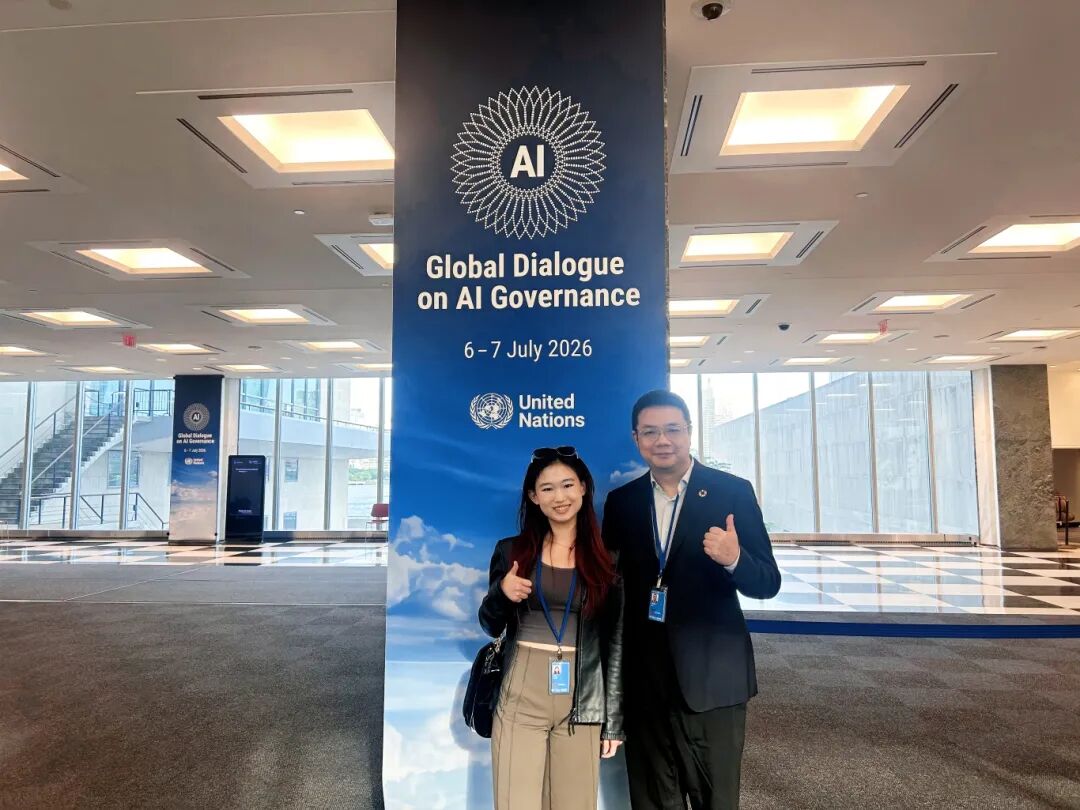
▲Tang Xing, Chairman of Grouphorse Group, and Guo Lingxin, Director of AI Data and Strategic Cooperation at Grouphorse Group, posed for a group photo in front of the themed signage of the "Global AI Governance Dialogue" at the United Nations.
Tang Xing stated that the essence of AI governance is by no means to "restrict" innovation, but rather to "build the foundation" for embedding artificial intelligence into more complex and higher-value commercial scenarios. At present, AI is accelerating its shift from "content generation" to "task execution," and the future landscape of industrial competition will move beyond the mere contest of parameters, computing power, and model performance, transitioning instead to a comprehensive assessment of enterprises' capabilities in systematic evaluation, risk identification, and governance implementation. High-quality data, model evaluation, and behavioral boundaries have already become the new generation of industrial infrastructure.
Under this trend, the value compass of data enterprises is undergoing a fundamental reshaping: the work that holds genuine long-term value is not merely to tell the model "what is correct," but also to teach the model how to act rationally in complex scenarios, when to firmly decline, and how to cut losses promptly when risks emerge.
Connecting international governance dialogue with industry practice.
Leveraging its multilingual data capabilities, university collaboration networks, experience in serving international organizations, and the methodological systems it has accumulated in data annotation, quality management, and professional language services, Grouphorse is further exploring high-quality data production for AI agents, complex task evaluation, cross-linguistic risk identification, and behavioral governance.
In the context of international cooperation on AI governance, Grouphorse will further leverage its strengths in cross-linguistic collaboration, international project delivery, and global resource connectivity, actively promoting cooperation with international organizations, technology companies, universities, and research institutions, and facilitating the alignment of China's data capabilities and governance practices with international rules, global application scenarios, and multilateral cooperation needs.
Grouphorse aspires to progressively build a service capability that spans the entire lifecycle of artificial intelligence:from scenario definition to data supply; from model training to capability evaluation; from risk identification to the implementation of governance rules.

▲Mr. Tang Xing, Chairman of Grouphorse Group, participated in the UN High-Level Meeting on AI and Emerging Technologies.
From China's accelerated implementation of the "AI+" initiative and its active participation in and promotion of international cooperation on AI governance, to the United Nations' continued deepening of multilateral discussions on AI governance, artificial intelligence is entering a new phase in which innovation, application, and governance advance in tandem.
Grouphorse will continue to build on high-quality data as its foundation, with model evaluation and behavioral governance as its extended capabilities, driving data services from "supporting model training" toward "supporting trustworthy intelligence." At the same time, leveraging its multilingual capabilities, experience in serving international organizations, and global cooperation networks, Grouphorse will work to effectively bridge China's data governance practices with international AI governance needs, providing professional support for the large-scale, international, and responsible application of artificial intelligence.