AI Hub
Official Side Event of the UN High-Level Political Forum on Sustainable Development: “Volunteering and Youth Leadership Empowering the Future of Sustainable Development” Held in New York
Updated:September 23, 2026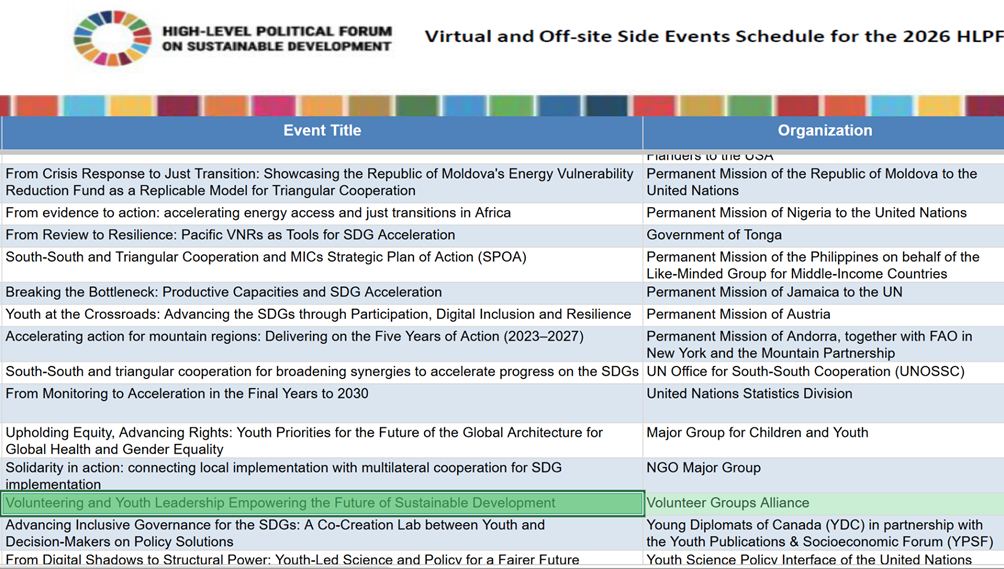
▲ Selected Official Side Events of the 2026 United Nations High-Level Political Forum on Sustainable Development (HLPF) [Source: UN Official Website]
On July 8, 2026, New York time, the 2026 United Nations High-Level Political Forum on Sustainable Development (HLPF) side event “Volunteering and Youth Leadership Empowering the Future of Sustainable Development” was held in New York. The event was led by the Volunteer Groups Alliance (VGA), with the Global Volunteer Forum, Chongqing Land-Sea International Forum Foundation, and Asia Center for Youth Development co-hosting it. Guests and youth representatives from international organizations, public-interest organizations, enterprises, universities, and secondary schools gathered to discuss how volunteering and youth leadership can accelerate the 2030 Agenda for Sustainable Development in the context of the International Year of Volunteers 2026.
The High-Level Political Forum on Sustainable Development (HLPF) is the UN’s core platform for following up on and reviewing progress in implementing the 2030 Agenda for Sustainable Development and the 17 Sustainable Development Goals. It is convened annually under the auspices of the United Nations Economic and Social Council and brings together ministers and senior government representatives from countries, heads of the UN system, and major stakeholders. Through thematic reviews and Voluntary National Reviews, the Forum promotes global policy coordination and implementation. The 2026 session was held at UN Headquarters in New York from July 7 to 15. Official side events authorized by the United Nations provide an important channel for stakeholders to contribute practical solutions and partnerships around the annual theme.
Opening Remarks
The side event was chaired by David Styers, Global Coordinator of the Volunteer Groups Alliance (VGA), who delivered the welcome remarks. He welcomed guests from near and far and noted that, as the International Year of Volunteers 2026 is being fully advanced, volunteering is increasingly becoming a key link connecting global goals with local action.
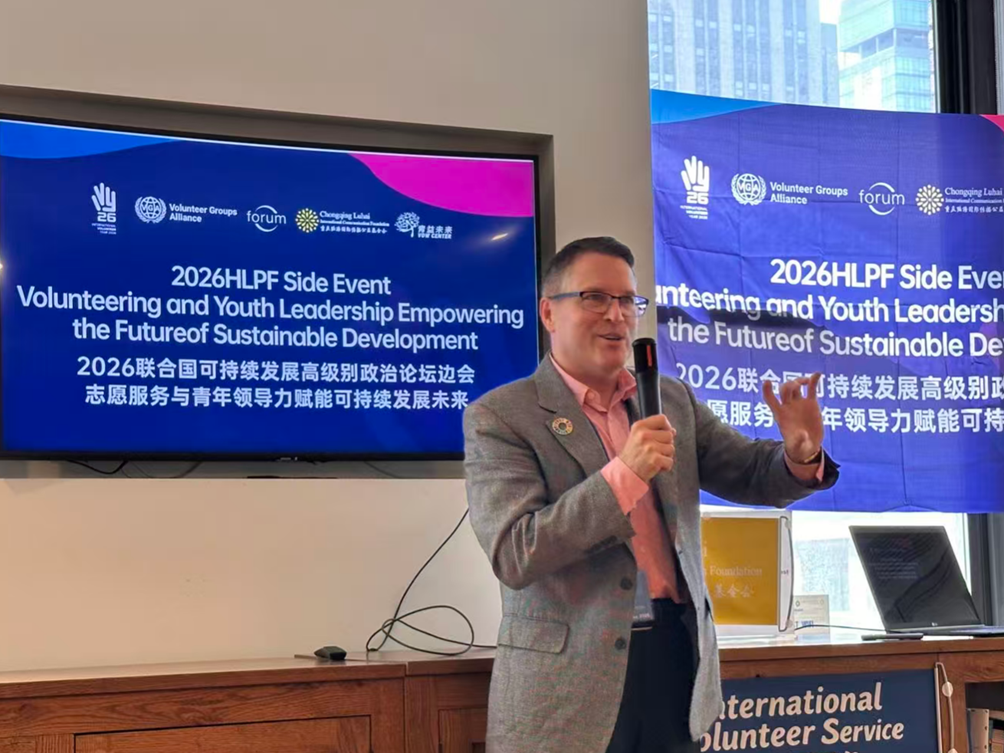
▲ David Styers, Global Coordinator of the Volunteer Groups Alliance (VGA), Chairs the Meeting
Keynote Sharing
Heather Shapter, Chair of the Board of the Global Volunteer Forum and Chief Executive Officer of Crossroads International, delivered a keynote address entitled “Pathways to Advancing the 2030 Agenda for Sustainable Development in the Context of the International Year of Volunteers 2026.” She noted that 2026 marks a critical stage in advancing the International Year of Volunteers, while the world faces multiple interconnected global challenges. This is an important moment to translate visions into action and commitments. She called for greater investment in the volunteering ecosystem, deeper global partnerships, and the integration of volunteering into sustainable development processes at all levels—respecting, protecting, and empowering volunteers is not only a tribute to those who contribute, but also central to strengthening community resilience, fostering solidarity, and building a shared future.
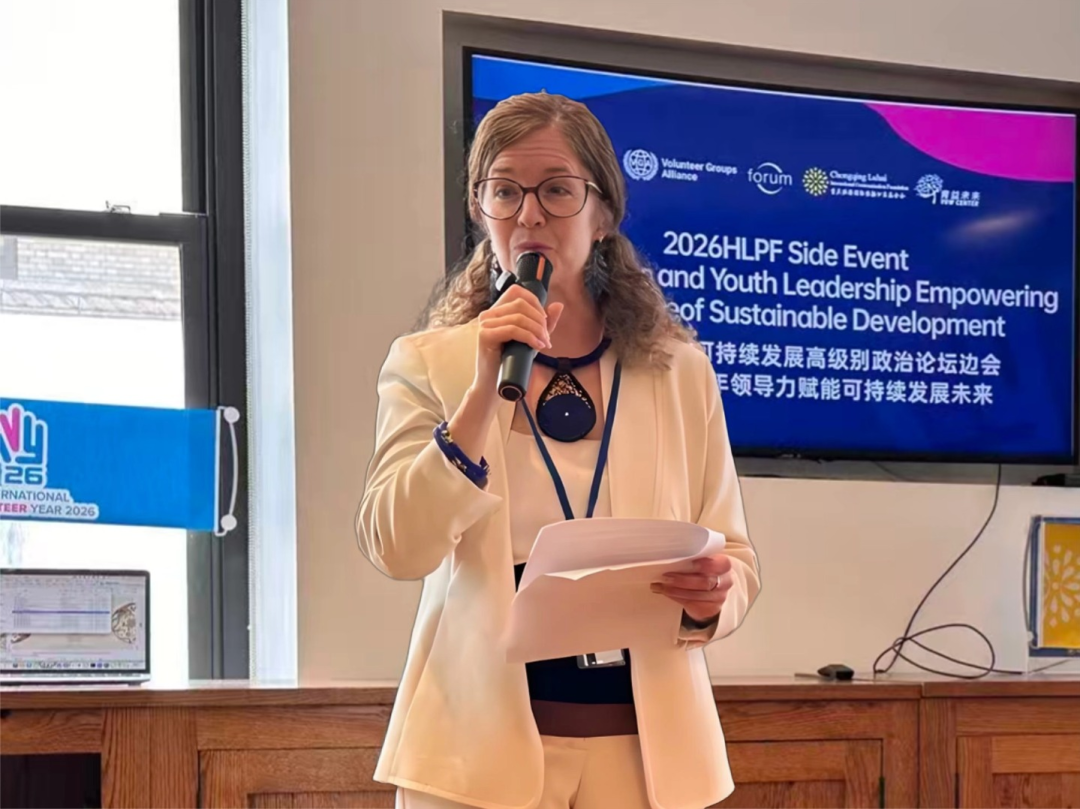
▲ Heather Shapter, Chair of the Board of the Global Volunteer Forum, Delivers the Keynote Address
Recognition, Support and Safeguards: Practices and Models of Volunteer Organizations in Asia
Chen Can, Deputy Secretary-General of the Chongqing Land-Sea International Forum Foundation, shared China’s exploration and practice in international volunteering. Focusing on pathways for integrating global volunteering standards with local development needs, she introduced a practical model of “global network connectivity—local capacity building—two-way service innovation,” developed around the International Volunteering Standards and the Action Initiative for the Future of Volunteering. The model provides a Chinese reference for countries seeking to deepen cooperation and implement the Sustainable Development Goals during the International Year of Volunteers 2026.
The meeting emphasized advancing SDG 6 (Clean Water and Sanitation) through volunteer participation, cross-sector cooperation, youth leadership, and community environmental action, while promoting regional cooperation in Asia to protect rivers and oceans.
Wang Muyao, Assistant to the Chairman of Grouphorse Group and a New York volunteer with Qingyi Future, delivered a presentation entitled “From Standards to Self-Assessment: A Practical Toolkit for Volunteer Organizations in the Data Age,” releasing and explaining the Global Volunteering Standards Self-Assessment Handbook and the International Volunteering Toolkit. She noted that beyond vision, local practice, and community action, the real question for a grassroots volunteer organization is “What should we do tomorrow morning?” Goodwill is the starting point of volunteering, while systems make it sustainable. The self-assessment handbook is an operational companion to the third edition of the Global Volunteering Standards: it is neither an external audit nor a certification review, but an “internal mirror,” covering 208 graded indicators across four themes and 13 areas (96 basic-level, 65 advanced-level, and 47 excellence-level indicators).
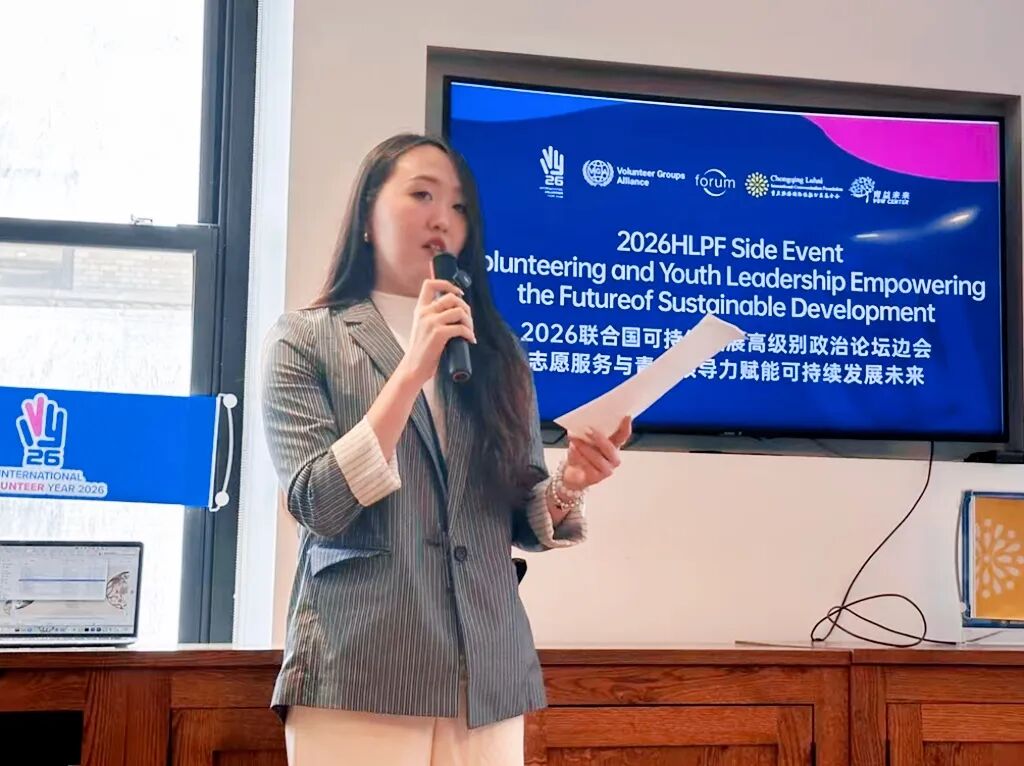
▲ Wang Muyao, Assistant to the Chairman of Grouphorse Group and Qingyi Future Volunteer, Delivers the Keynote Address
The three supporting practical toolkits include 59 operational tools and templates in the Standards Management Toolkit, 365 volunteer activity ideas aligned with the SDGs in the Activity Inspiration Pack—corresponding to every day of the International Year of Volunteers—and 100 diverse and inclusive activities in the Interactive Games Pack. Physical copies of the handbook and toolkits were displayed on the exhibition table for participants to browse and try. She noted that a basic-level self-assessment takes just over three hours from start to finish and often gently reveals “quiet gaps” within an organization. She also pledged to assist grassroots organizations in Asia and other regions in completing their first self-assessment during the International Year of Volunteers.
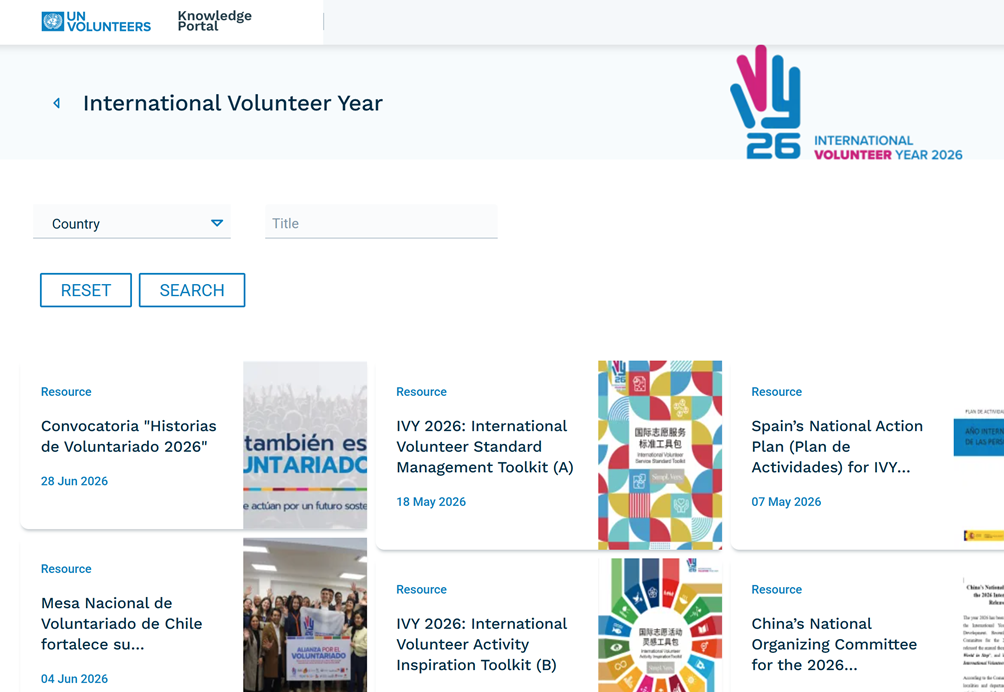
▲ The Volunteering Toolkit Introduced by Wang Muyao Is Now Available on the UN Website
From Evidence to Action: Youth Innovation, Technology Empowerment, Digital Governance, and Inclusive Infrastructure
During the youth lightning-talk session, five youth representatives took the stage in turn around the theme “Accelerating the Development of Volunteering and the Implementation of the SDGs.”
Zhang Shiyang, Chairman of the Chongqing High-Tech Zone Sunshine Youth Development Research Center, introduced Chongqing’s practice of “From Volunteer to Changemaker”: medical professionals and international youth worked together to provide public-interest services such as psychological counseling and depression screening in mountainous areas of Chongqing and Sichuan. Through collaboration between Chinese and international youth, the initiative seeks to strengthen cross-cultural collaboration and global health governance capabilities, with plans to bring the program to Kenya and Thailand in partnership with overseas youth.
Hu Hanrui, head of the Volunteer Service Guidance Center of the Youth League Committee of China University of Labor Relations, explained how university volunteer initiatives can provide young people with low-cost, high-value platforms for practical growth. While strengthening overall competence and practical skills, these initiatives continuously foster young people’s sense of social responsibility and leverage youth-led volunteer innovation to advance the global Sustainable Development Goals.
Liang Kangyue, a student volunteer from Shanghai Star River Bilingual School, delivered an English-language speech entitled “The Algorithm and the Ancestor — Safeguarding Living Heritage in the Age of the Feed.” Citing 2026 data from the UNESCO Institute for Statistics (UIS), she noted that the number of countries participating in the SDG indicator 11.4.1 survey had doubled from 2020 to 92, while per-capita public expenditure on cultural heritage still ranged widely, from 1 international dollar to more than 500. “This gap is not an accounting detail; it determines which cultures survive and which are quietly erased,” she said. She noted that short-video platforms measure content through completion rates within 15 seconds, while users take only 1.4 to 3 seconds on average to decide whether to scroll away. By contrast, intangible cultural heritage such as Xinjiang Uyghur Muqam and Korean ethnic Nongak dance in China relies on extended musical and dance sequences and epic-like pauses. In the competition for a few seconds of attention, historical depth, communal rituals, and spiritual substance are often cut away, leaving only spectacle. Drawing on 15 years of Chinese dance training and nearly six months of interviews, she identified two major issues: artistic forms adapting to online aesthetics and becoming commercial spectacles, while learners become detached from field settings and historical contexts through digital dissemination and lose their “localized experience.” The same phenomenon exists across many forms of living heritage worldwide.
Drawing on her experience teaching Chinese dance to children and older adults on a voluntary basis, as well as conducting research at the former residences of Cai Yuanpei and Soong Ching Ling and planning humanities-oriented walking routes, Liang Kangyue proposed three initiatives: governments and international funds should invest in long-term capacity building and continue supporting countries with low heritage expenditure; local intangible cultural heritage education should be improved to curb “decontextualization”; and UNESCO should incorporate a “contextual integrity standard” into heritage guidelines, requiring digital content to include community context and transmission lineages and involving young heritage bearers in oversight. She said, “We are not merely spectators of tradition; we are also its future inheritors. Cultural heritage should not be flattened into a three-second spectacle, but remain a living relationship among body and memory, community and place, and past and future.”
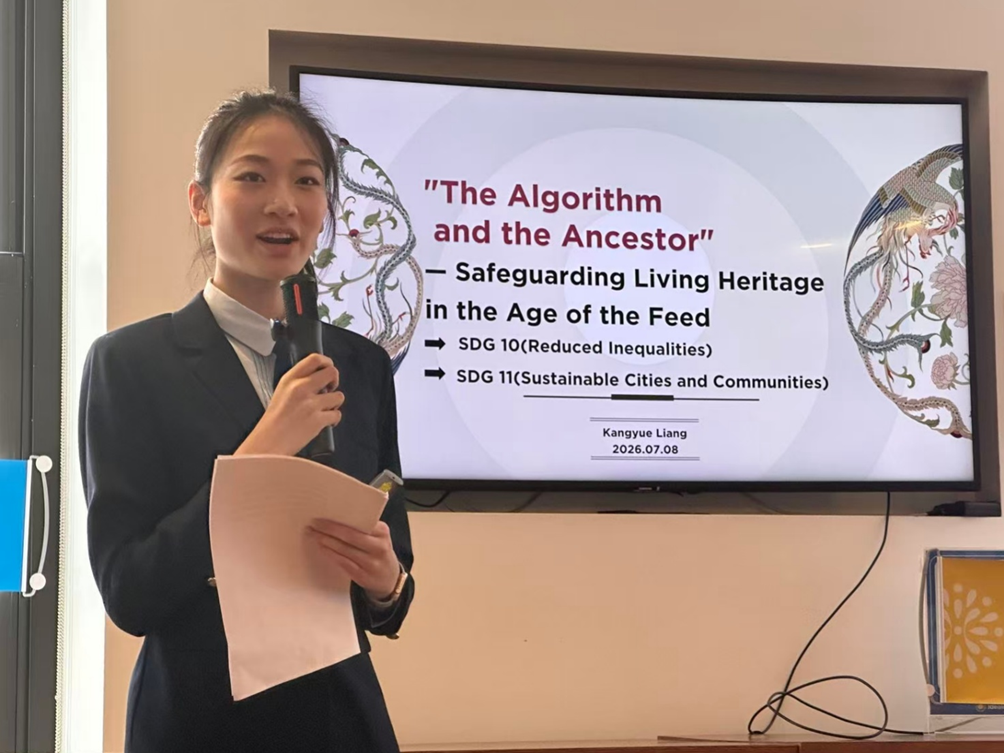
▲ Liang Kangyue of Shanghai Star River Bilingual School Speaks as a Youth Representative
Xu Anran, a student volunteer from the High School Affiliated to Southwest University, used the mini-program “Urban Birdsong” that she developed independently to demonstrate how AI-powered recognition and a cloud-based dynamic observation map can lower barriers to public participation in ecological volunteering and build an urban biodiversity database. She called on young people to become actors in digital governance, transforming individual volunteer actions into scientific ecological evidence and accelerating inclusive implementation of SDG 11 and SDG 15 in cities.
Lu Jingchao, a student volunteer from Shanghai Baoshan Shiwai School, shared a zero-waste initiative inspired by Fudan University’s project that turns marine litter into floating islands. Using discarded plastic bottles and other materials, he created an ecological floating island called “Birdtopia,” illustrating from a young person’s perspective the value of technology-enabled ecological conservation and inclusive infrastructure: “Young people can have aspirations, and they can start taking action and become an important leg in the relay race for sustainable development.”
On-Site Exchange and Appreciation
During the open-floor session, participants actively shared their thoughts and perspectives on topics including the standardization of volunteer services, youth participation in global governance, and the digital preservation of cultural heritage. The moderator, on behalf of the organizers, expressed gratitude to all guests, participants, and supporting organizations, and the side event concluded in a lively atmosphere.
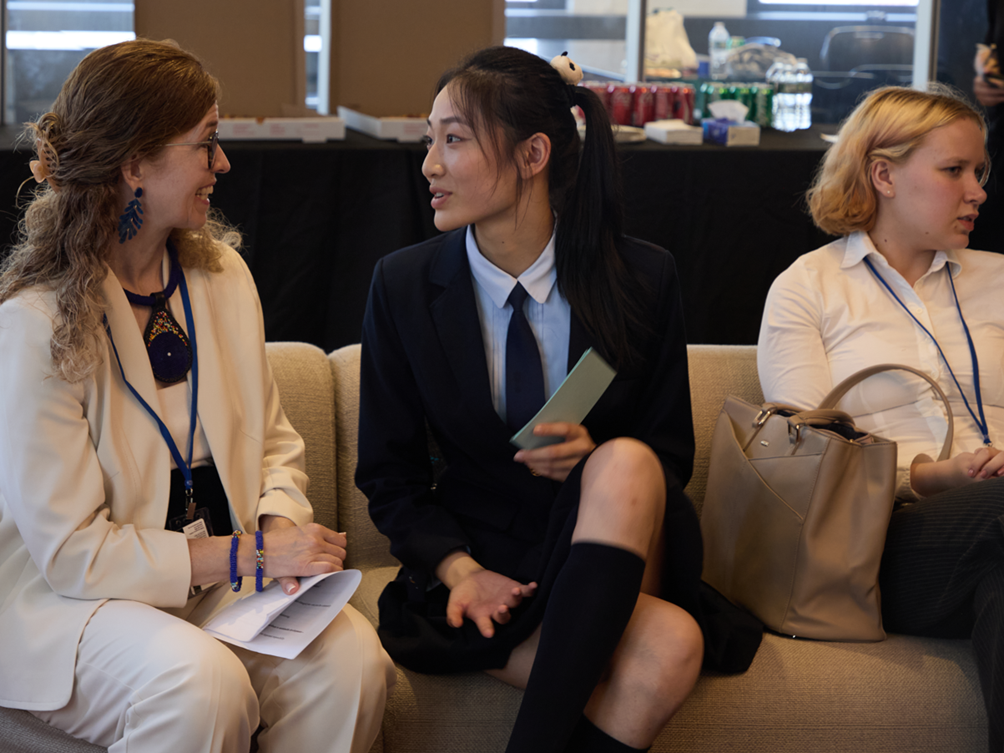
▲ Liang Kangyue (center) in conversation with Heather Shapter (left) after the event
2026 is the International Year of Volunteers. Through real-world cases and replicable tools, this side event demonstrated that, from global standards to community action and from river cleanup to heritage conservation, volunteering is becoming one of the most dynamic forces for advancing the 2030 Agenda for Sustainable Development, with young people at the forefront of this relay.
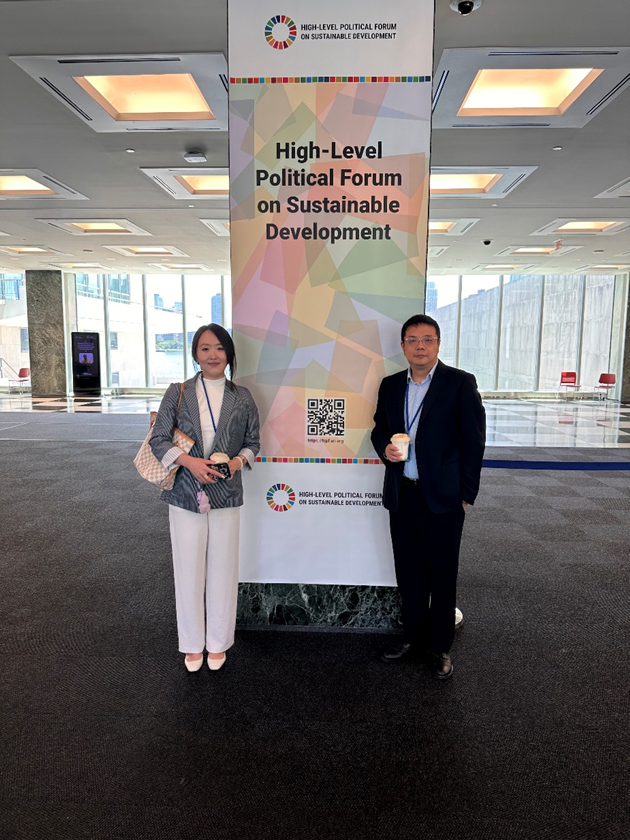
▲ Grouphorse Group Chairman Tang Xing (right) and Assistant to the Chairman Wang Muyao (left) Attend the UN High-Level Political Forum on Sustainable Development at UN Headquarters in New York